
Terminal value tutorial workbook
Excel binary workbook (.xlsb). A project with quarterly cash flows over 10 years, with terminal value estimated three ways and added before the NPV.
Enter your details and we will email you the workbook.
Loading the form…
The form did not load. Send us an enquiry and we will email you the workbook.
Terminal value is the value of a project’s expected cash flows beyond the explicit forecast period. It often makes up a large share of project value in a discounted cash flow valuation, so a sound estimate matters.
Net present value (NPV) values a project or investment from its future cash flows. A firm or project may have an indefinite life, so its value is the NPV of its cash flows for an indefinite period.
Forecasting beyond a certain point is impractical, though. Revenue, costs and industry and economic conditions are hard to predict more than a few years out, which limits how far a forecast can be trusted.
A terminal value captures the value at the end of the forecast period. It brings in the value of cash flows beyond the projection period without forecasting them one by one. We cover it in depth in our Financial Modelling for Corporate Finance course.
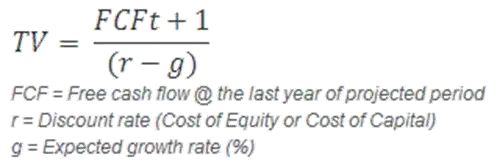
Because terminal value often accounts for a large share of total project value, analysts and modellers need to know how it is calculated. The workbook shows the methods below in a project finance model.
Three ways to estimate terminal value
- Multiple of earnings before interest, tax, depreciation and amortisation (EBITDA)
- Perpetuity
- Perpetuity with growth
In practice, academics tend to use the perpetuity growth model, while project financiers favour the exit multiple. The two are different ways of saying the same thing. Whichever you use, test a range of discount rates, multiples and growth rates to set a sensible valuation range.
Learn this in a room
Financial Modelling for Corporate Finance
Integrated three-statement models: working capital, funding and valuation. For FP&A, Treasury and Strategy teams. Practitioner-led, in person or online.
The EBITDA exit multiple method
The EBITDA multiple method values the enterprise, that is, the business operations only. The terminal value is:
Terminal value=EBITDA (final year) × exit multiple
The present value (PV) of the terminal value is then added to the PV of the free cash flows in the forecast period to give an implied firm value.
The multiple comes from publicly traded comparable companies. This is the simplest method, but depending on the purpose of the valuation the EBITDA multiple may not give a suitable range. Other multiples used for terminal value include:
- Price to earnings (P/E)
- Market to book
- Price to revenue
- Earnings before interest and tax (EBIT)
The perpetuity growth method
The perpetuity growth method assumes free cash flow keeps growing at a constant rate for ever. The terminal value is:
Terminal value=FCF (final year) × (1 + g)r − g
where FCF is free cash flow, g is the stable growth rate and r is the discount rate.
Which growth rate should you use? The constant rate is called the stable growth rate. Past growth is not always a reliable guide, but current and future growth are related: a project growing at 10% now probably has higher growth, for longer, than one growing at 5% a year.
The growth rate is hard to estimate, and an inaccurate one gives the wrong value. Analysts sometimes leave growth out altogether, the perpetuity method, for a more conservative terminal value.
Modelling terminal value in the workbook
The workbook assumes a project with a 12-month construction period and quarterly cash flow projections over 10 years, and shows all three methods. Each needs the EBITDA or free cash flow for the last year of the forecast period. The simplest way to pick it out is a binary (1, 0) flag, as Figure 2 shows.
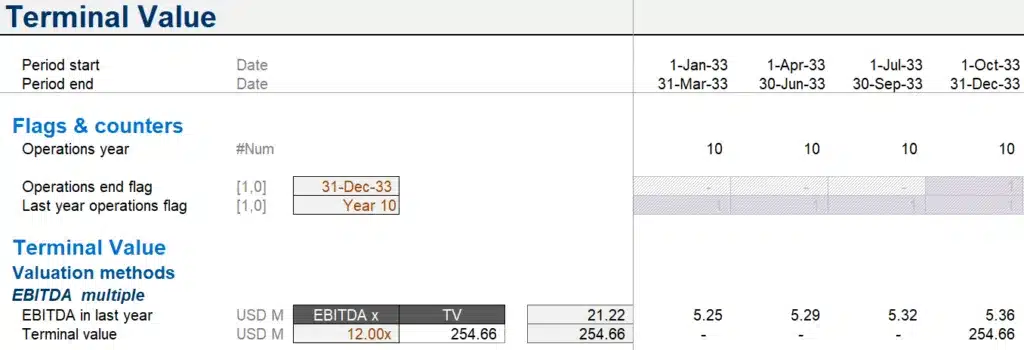
The terminal value calculation itself is simple. Figure 3 shows the EBITDA multiple method.

The last step is to add the terminal value to the project cash flow before calculating the NPV. In the workbook, the perpetuity method is the one selected.
Terminal value mistakes to avoid
- Take the EBITDA or cash flow for the whole last year of the forecast period. A common mistake is to take only the last quarter or month
- Add the terminal value to the project cash flow before calculating the NPV. The valuation does not stop at the terminal value itself
- Choose a multiple, growth rate and discount rate that suit the project’s risk, because they drive the result
- Show clearly whether the calculation is before or after tax
Terminal value questions
What is terminal value in financial modelling?
The value of a project’s expected cash flows beyond the explicit forecast period: the value the project keeps generating after the years a model forecasts one by one.
Should I use the exit multiple or the perpetuity growth method?
Neither is wrong. Academics tend to favour perpetuity growth, while project financiers more often use the exit multiple. Test both across a sensible range of assumptions, because terminal value often makes up a large share of total project value.
Why do analysts sometimes leave the growth rate out?
An inaccurate growth rate can distort the terminal value a great deal. Leaving it out gives a more conservative estimate where the growth assumption is uncertain.
What is the most common mistake in modelling terminal value?
Taking only the final quarter or month of cash flow or EBITDA instead of the full final year. That understates the base the terminal value is built on and can misstate the valuation.