
Training Courses
Financial Modelling for Corporate Finance
Integrated three-statement models: working capital, funding and valuation. Build fully integrated three-way models, robust DCF valuations and flexible scenario analysis, using the same proven methodology whether you are managing a debt facility, evaluating a growth initiative or advising on a transaction.
See dates & pricesSend enquiry- 2 daysPractitioner-led
- Hands-onYou build the model,
not watch one being built - In person or digitalDelivered in person
and worldwide online - Take awayThe completed model files
and templates
See what you build
A transparent, fully built model, not just a template
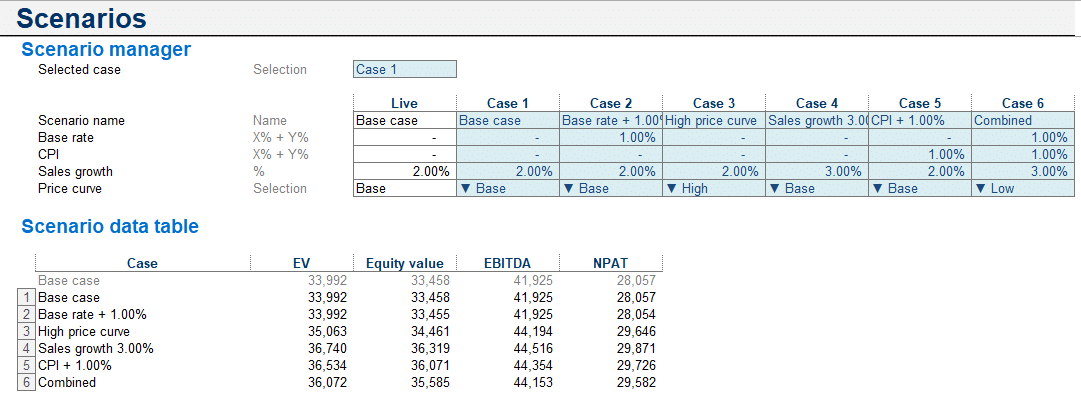
The scenario analysis below is a real extract from a completed course model, built on the valuation techniques this course covers. This is the working structure you build in this course, from the target company model through to a fully cross-referenced valuation.
Who this is for
Financial modelling for the wider finance function
Financial Modelling for Corporate Finance is built for anyone who builds, uses or presents financial analysis as part of their role, not only investment bankers and corporate finance specialists. FP&A, Treasury, Capital Markets and Strategy & Corporate Development teams all rely on the same underlying skill: a structured, transparent, reliable model.
No prior financial modelling course is required. Working confidence in Excel is assumed; the course builds the modelling methodology from first principles before applying it to a full company model.
You will get the most from this course if
- You build, use or present financial models as part of your role, in any function
- You prepare business cases for capital investment or evaluate growth initiatives
- You need a repeatable methodology for fully integrated three-way models
- You want practical, first-principles grounding in DCF valuation and WACC
What you will learn
Build and value a fully integrated company model
Ten modules take you from modelling methodology through to a complete, valued three-way model, using a real target company as the working example throughout.
Master proven modelling technique
- Work with a powerful, easy to follow financial modelling methodology
- Compare good versus bad modelling technique against real-life examples
- Increase consistency across your team in calculation technique and presentation
Design a model structure
- Investigate the key modules of a model and the building block components
- Understand the design flow of the model builder
- Build a fluid timing architecture with binary flags suitable for every module
- Develop a layout hierarchy with custom styles for a transparent, well-presented model
Build a model of the target company
- Use best practice to build company operations, from revenue to results
- Calculate revenue from multiple units and time-variable pricing
- Model operational costs, both fixed and variable
Working capital and cashflow
- Build working capital into an existing model without changing its structure
- Understand the impact of working capital on cashflow
- Discuss common errors in modelling working capital and how to model around them
Finalise the three-way model
- Reforecast the target company’s balance sheet including debt, share capital and tax
- Add a capital programme and construct best-practice depreciation calculations
- Complete the P&L, balance sheet and cashflow waterfall
- Explore the company’s net asset position and its role in valuation
WACC using CAPM
- Discuss the theoretical underpinnings of CAPM and why it is used
- Derive the WACC formula and model it in Excel
- Learn how to estimate betas from actual public market data
Terminal value analysis
- Understand why terminal value is not appropriate in some valuation models
- Learn how different factors affect the impact of terminal value on a valuation
- Calculate terminal value using the perpetual growth model and other methods
Best-practice DCF valuation
- Discuss NPV from first principles and apply XNPV functionality
- Integrate a dividend policy and restrictions into a model and understand the impact on valuations
Cross-reference valuation techniques
- Learn the pros and cons of relying on any single valuation technique
- Compare DCF valuation outputs with EBITDA and transaction multiples
Scenario manager for decision making
- Save critical time and deliver rapid analysis with our approach to scenario management
- Test the model in every scenario, not just the base case
- Build confidence in your analysis through pre-programmed combinations of model inputs
Next available dates
Upcoming courses
How the course runs
You learn modelling by modelling
Interactive, instructor-led and built on a single modelling standard that has been taught to more than 20,000 people. You build the model yourself with individual coaching through every exercise, and you keep the completed files.
This course also runs privately: see in-house training for delivery built around your team and sector, or browse the full course portfolio.
Our trainers
Learn from a practitioner
Our courses are led by experienced members of our financial modelling and model audit teams. The trainers below run this course frequently, but your session could be led by any member of our team.

Joshua Grimm
Director, Singapore
Joshua leads the development and delivery of financial modelling training courses for Forvis Mazars in Asia. His expertise covers areas such as project finance modelling for large-scale renewable energy, utilities and infrastructure projects, as well as corporate finance modelling for M&A transactions and internal FP&A. He has supported clients with their projects from feasibility through financial close, all the way to operations.

Ben Kwan
Partner, Sydney
Ben is an experienced financial modeller with a background in transaction teams and as a lead financial modeller in industry. He has experience building a wide range of models across multiple sectors. Ben leads APAC Model Audit at Forvis Mazars, where he reviews models to support clients on bid submissions, financing processes and internal governance requirements.

Keshav Rana
Associate Director, London
Keshav is an Associate Director in London, managing the financial modelling training business across EMEA. He is an experienced financial modeller with more than 10 years of financial modelling experience, having worked on global projects in renewables (primarily solar and wind), utilities and telecom, as well as a range of corporate and portfolio forecasting and valuation models. Keshav’s focus now is developing and delivering financial modelling training courses, providing tailor-made courses to meet the needs of clients across an ever-changing landscape in the infrastructure and energy sectors.
Book this course
Dates, prices and online booking are on the course schedule. Not sure it is the right course? Ask us.
See dates & pricesSend enquiry