
Working capital tutorial workbook
Excel binary workbook (.xlsb). The working capital adjustment for trade debtors and creditors from this tutorial, linked to the statements.
Enter your details and we will email you the workbook.
Loading the form…
The form did not load. Send us an enquiry and we will email you the workbook.
Trade debtors and trade creditors capture a company’s cash cycle, so a cash flow model needs both. Not all revenue earned in a period is received in that period, and not all costs are paid as soon as they are incurred.
Trade debtors are cash owed by customers who have bought goods or services. Fewer debtor days means cash comes in from customers faster.
Trade creditors are suppliers the company owes cash to. More creditor days means cash stays in the company for longer.
Funding working capital
Every business has to manage its day-to-day cash cycle. If it pays its creditors before its debtors pay it, it has a short-term working capital gap to fund. Ways to fund it include:
- Cash or a savings account
- An overdraft facility
- A working capital facility
- A short revolving credit facility
- Other types of debt finance
Learn this in a room
Financial Modelling for Corporate Finance
Integrated three-statement models: working capital, funding and valuation. For FP&A, Treasury and Strategy teams. Practitioner-led, in person or online.
Modelling working capital
The main variables are:
- Trade debtors: revenue and debtor days
- Trade creditors: costs payable and creditor days
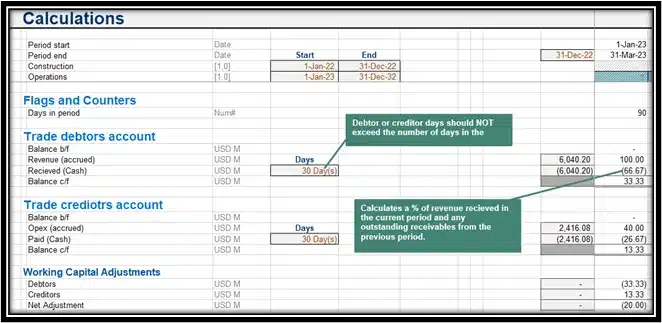
The most transparent and efficient way to model working capital in a cash flow model is a working capital adjustment in every period. The debtors adjustment is the difference between revenue receivable and revenue received. The creditors adjustment is the difference between costs payable and costs paid. Figure 1 shows the calculation.
- Income statement. Link revenue receivable and costs payable directly to the income statement.
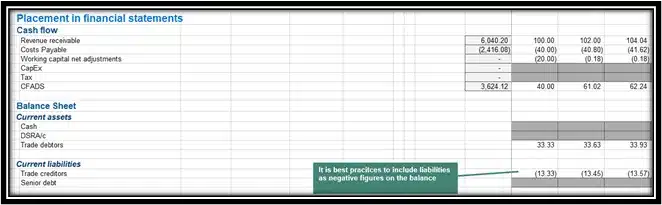
- Cash flow waterfall. Revenue receivable and costs payable from the income statement link to the cash flow waterfall. The working capital adjustments are added just before cash flow available for debt service (CFADS).
- Balance sheet. Trade debtors are usually recoverable, and trade creditors usually due, within one year. Trade debtors go in current assets, below more liquid assets such as cash or a debt service reserve account. Trade creditors go in current liabilities, as Figure 2 shows.
Common working capital modelling mistakes
Making it complicated
Trade debtors and creditors can be modelled transparently and efficiently. Squeezing the calculation into one line hides mistakes and undermines the whole cash flow model.
Linking back to the statements incorrectly
Problems arise where the timing changes partway through the model, for example from monthly to quarterly periods. Setting out the number of days in each period, as in Figure 1, solves this.
Other ways to model working capital
Received or paid in the next period
Revenue is assumed to be received, and costs paid, in the period after they arise.
A percentage in periods N, N+1 and N+2
Revenue received or costs paid are a set percentage of revenue receivable or costs payable, spread across periods N, N+1 and N+2.
Working capital questions
What is the difference between trade debtors and trade creditors?
Trade debtors are amounts customers owe the company for goods or services already sold. Trade creditors are amounts the company owes its suppliers. Debtor days measure how fast cash is collected; creditor days measure how long the company holds cash before paying suppliers.
Why does the working capital adjustment sit before CFADS?
CFADS is the cash a project generates in the period, not the revenue and costs recognised in it. The working capital adjustment turns revenue receivable and costs payable into the cash actually received and paid before it reaches CFADS.
What is the most common mistake in modelling working capital?
Squeezing the calculation into a single line instead of a transparent adjustment in every period. A one-line approach hides errors and makes the cash flow harder to review.
Where do trade debtors and creditors go on the balance sheet?
Trade debtors go in current assets, usually below more liquid items such as cash, because they are usually recovered within one year. Trade creditors go in current liabilities on the same basis.