
Cash flow waterfall tutorial workbook
The cash flow waterfall from this tutorial, built out in Excel and ready to follow along with your own numbers. Excel binary workbook (.xlsb).
Enter your details and we will email you the workbook.
Loading the form…
The form did not load. Send us an enquiry and we will email you the workbook.
In project finance, a project’s cash flow is summarised in a cash flow waterfall, which shows the priority of every cash inflow and outflow. The waterfall makes sure each cash flow item sits at the right seniority relative to every other item. That matters most when the model repays several debt tranches of falling seniority.
The cash flow waterfall is covered in our Best Practice Project Finance Modelling course, with further detail in Advanced Project Finance Modelling. For a recorded walkthrough, watch our cash flow waterfall webinar.
Cash flow waterfall categories
A cash flow waterfall is simple in its approach: every cash flow item is placed in the order in which it occurs. The main categories, in order, are:
- Revenue: operating revenue and other income
- Expenses: operating expenses and capital expenses
- Tax
- Debt service: principal repayments and interest paid
- Distributions
- Net movement in the cash balance
The cash flow lines it calculates
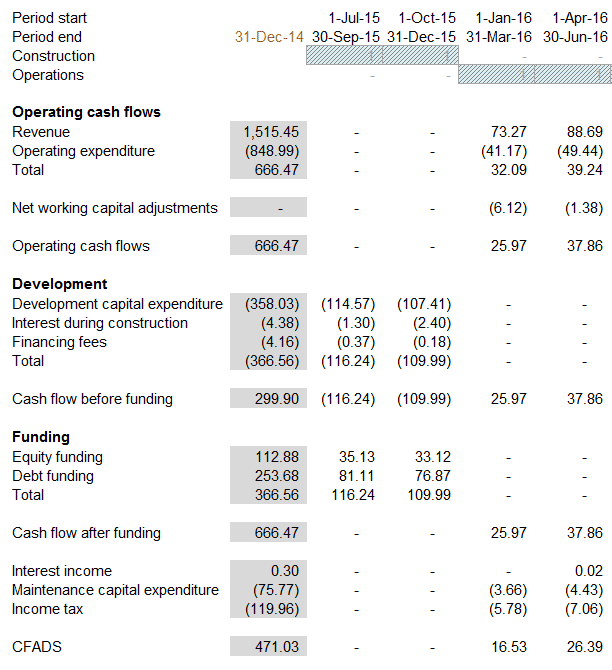
The waterfall calculates the cash flow lines used across a project finance model:
- Cash flow available for debt service (CFADS): the most important line, which drives every debt repayment calculation and ratio, including the debt service coverage ratio (DSCR), the project life cover ratio (PLCR) and the loan life coverage ratio (LLCR)
- Cash flow before funding: a quick check that initial construction costs are being met by debt or equity
- Cash flow available for the debt service reserve account (DSRA) or another reserve account
- Cash flow available to equity, to calculate distributions
- Net cash flow
Learn this in a room
Best Practice Project Finance Modelling
Build and sensitise robust cashflow models from scratch, faster in Excel. Hands-on, practitioner-led, in person or online. See dates and book your place.
Cash flow statement and cash flow waterfall compared
How cash flows are grouped
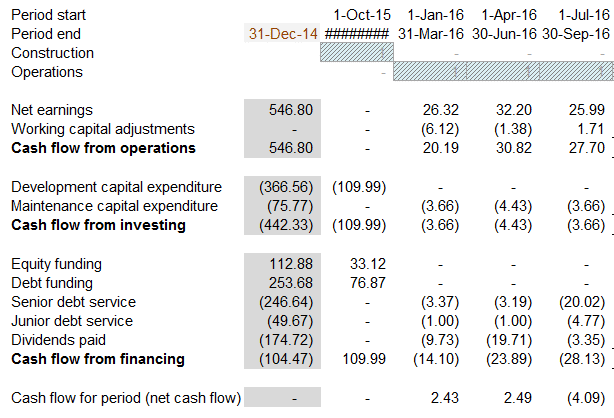
The cash flow statement presents cash flow in three categories that stand alone from one another: cash flow from operations, from investing and from financing.
Seniority of cash flow items
The cash flow statement does not order cash flows by seniority, which makes it less useful for analysing a project’s ability to repay debt. The waterfall shows the cash flow available at each level, as the term sheet describes.
Who each one is for
The cash flow statement gives information an external investor can analyse readily. The waterfall gives information the banks can analyse easily.
Seniority, annual summaries and the negative cash check
- The term sheet sets the seniority of some categories, such as reserve accounts. An annual cash flow waterfall makes the model much easier to use, because it supports analysis at a high level. Code it with SUMIF on calendar year, financial year or operating year.
- Make sure debt is repaid in the order of seniority of the tranches. This matters most in downside sensitivities and scenarios, where operating cash flow is heavily stressed.
- The waterfall calculates the net movement in cash and the closing cash balance. An integrity check on this line that flags a negative closing balance (balance carried forward) is a critical part of a complete model. Without it, a project can appear to be funded by a negative cash balance, which is not a realistic scenario.
Cash flow waterfall questions
What is a cash flow waterfall in project finance?
A presentation of a project’s cash flows in order of seniority: revenue, operating and capital expenses, tax, debt service, distributions and the net movement in cash. It makes sure every cash flow item is paid, or reserved for, in the right order relative to every other item.
How is a cash flow waterfall different from a cash flow statement?
A cash flow statement groups cash flows into operations, investing and financing, which suits an external investor’s view of the business. A cash flow waterfall orders cash flows by seniority as the term sheet defines it, which is the structure lenders need to assess repayment capacity.
Why does seniority matter in a cash flow waterfall?
Seniority sets the order in which claims on cash are met. Where there are several debt tranches or reserve accounts, the waterfall must follow the term sheet’s ranking, not an assumed one. Paying a lower-ranked item before a higher-ranked one misstates the project’s debt capacity.
What integrity checks should a cash flow waterfall include?
At least a check that flags a negative closing cash balance in any period. Without it, a model can imply that a project is funded by a negative cash balance, which is not realistic and usually points to an error elsewhere in the funding or the waterfall.