
LLCR tutorial workbook
The LLCR calculation from this tutorial, built out in Excel and ready to follow along with your own numbers. Excel binary workbook (.xlsb).
Enter your details and we will email you the workbook.
Loading the form…
The form did not load. Send us an enquiry and we will email you the workbook.
How the LLCR is calculated
The loan life coverage ratio (LLCR) measures how many times the discounted cash flow over the remaining loan life could repay the outstanding debt. The DSCR checks repayment capacity period by period. The LLCR takes a whole-of-loan view, which makes it a useful indicator of a project’s long-term ability to service its debt.
In a project finance transaction, lenders require regular reporting of financial ratios. The LLCR compares the present value of future cash flow available for debt service (CFADS) with the outstanding debt balance.
The present value of future debt service is mathematically equal to the debt balance carried forward, which gives this formula:
LLCR=NPV of CFADS over the loan lifedebt balance c/f
The discount rate in the NPV calculation is typically the weighted average cost of debt for the facility, though the term sheet will specify it. Where the weighted average is used, it is typically calculated as:
Discount raten=interest expensendebt balancen

Learn this in a room
Best Practice Project Finance Modelling
Build and sensitise robust cashflow models from scratch, faster in Excel. Hands-on, practitioner-led, in person or online. See dates and book your place.
Capping qualifying CFADS at the loan life
The ratio is calculated from the period after the reporting date to the end of the loan life. The qualifying CFADS, the cash flow included in the numerator, must be capped at the final debt service period. The ratio is not calculated at the final debt service period itself, because the outstanding debt balance at that point is zero.
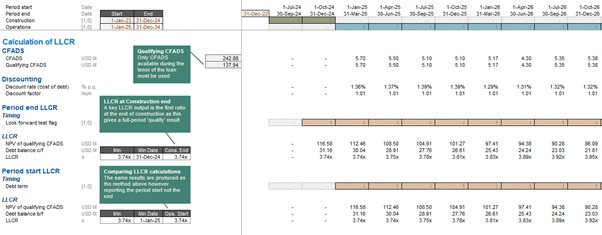
The model above calculates both the construction-end and the period-start ratio across the loan life. The minimum is tracked and used as a covenant output. Binary flags isolate the qualifying CFADS within the loan tenor, so cash flow after the debt maturity date is left out of the calculation.
What a ratio of 2.00x or 1.00x means
A ratio of 2.00x means the discounted CFADS over the loan life is double the outstanding debt, a strong coverage position.
A ratio of 1.00x means discounted CFADS exactly equals the debt balance. The point at which a variable produces 1.00x is the break-even, a useful measure of project economics. On a toll road, for example, the project might reach break-even at a 38% fall in patronage from the base case, compared with a DSCR break-even that might be only 20%.
Including the DSRA balance
Lenders sometimes allow other cash deposits to count in the calculation. The most common version adds the debt service reserve account (DSRA) balance to the numerator:
LLCR=NPV of CFADS over the loan life + DSRA balance c/fdebt balance c/f
Take care when the DSRA balance is included. Add it to the NPV of CFADS directly: it should not be discounted as part of CFADS. Always check the exact definition against the term sheet.
Period end or period start
The ratio can be calculated at either the start or the end of a period.
- Period end: use cash flow from the next period onwards and the closing debt balance
- Period start: use cash flow including the current period and the opening debt balance
Both give the same result. The difference is the reporting date. Confirm the convention in any model you build or review.
Common modelling errors in the LLCR
The formula is simple, but errors are common in practice. Watch for these:
- The definition has not been checked against the debt term sheet
- CFADS is not capped at the end of the loan life or debt maturity (see our CFADS tutorial)
- Inconsistent timing: the numerator uses period-start cash flow while the denominator uses the closing debt balance
- CFADS is not clearly presented in the cash flow waterfall, so the ratio references the wrong line
- The DSRA balance is discounted as part of CFADS instead of being added directly to the NPV line
- The discounting method in the covenant calculation differs from the one in the debt service calculation
- The wrong periodic discount rate is used in the NPV calculation
- LLCR covenants trigger cash sweeps while the model also includes interest on reserve accounts, creating a circular reference
- XNPV is used with a variable discount rate, or with a periodic rather than an annual rate
For more common modelling mistakes, watch our webinar top 10 errors in financial models and how to fix them.
Sensitivity and scenario tables
Showing the ratio in sensitivity and scenario tables gives lenders and sponsors a clearer picture of downside risk. For how to structure these tables, watch our webinar on sensitivity tables.

What is the difference between LLCR and PLCR?
The LLCR and the project life cover ratio (PLCR) are closely related but measure different things.
- The LLCR covers cash flow during the loan life only
- The PLCR covers cash flow across the whole project life, beyond the loan term
Confusing the two is a common modelling error. Binary flags that cap CFADS at the end of the loan tenor are the most reliable control. To learn how to use flags, watch our webinar on mastering flags. For the loan life ratio in a recorded session, watch our LLCR webinar.