
Cash sweep tutorial workbook
The stand-alone cash sweep from this tutorial, built out in Excel and ready to follow along with your own numbers. Excel binary workbook (.xlsb).
Enter your details and we will email you the workbook.
Loading the form…
The form did not load. Send us an enquiry and we will email you the workbook.
Stand-alone cash sweep analysis is another way to measure refinance risk and repayment ability in a project finance cash flow model. This tutorial sets out the main features of a cash sweep calculation and how to use it to analyse a project finance model.
During a cash sweep, 100% of cash flow available for debt service (CFADS) is used to repay principal and interest.
Stand-alone cash sweep analysis calculates how long it takes to repay the debt in full. Do not confuse it with the cash sweep mechanics governed by the term sheet.
It is an alternative to reading debt ratios such as the loan life coverage ratio (LLCR) and the project life cover ratio (PLCR), which also analyse the project’s ability to repay debt. It is a quick, useful way to analyse the effect of downside scenarios.
How cash sweep analysis is used in a project finance model
Cash sweep analysis can be applied to the base case, but it is most useful across a series of downside scenarios. A sweep that shows the debt fully repaid in the most conservative downside scenario supports the soundness of the project.
Quicker to model
It is easier to set up than all the mechanics needed to model a term sheet cash sweep triggered by financial covenants, but gives a comparable level of analysis.
Dynamic start date
The start date of the sweep can be an input, which makes it flexible. Set it to the start of the debt facility, the end of completion or the debt maturity to analyse refinance risk.
Clearer communication
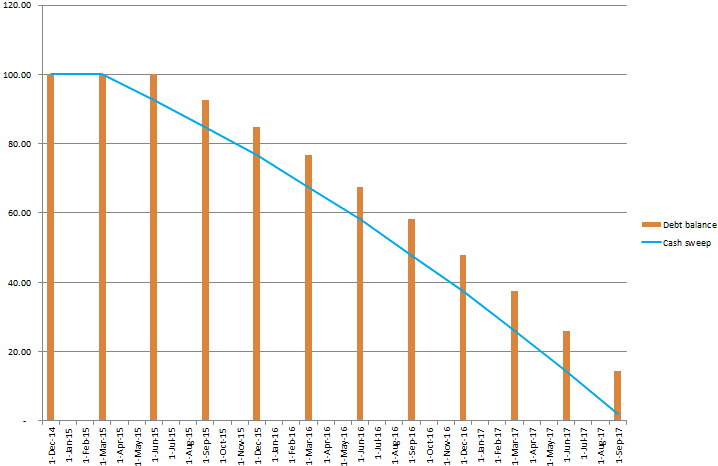
A chart of the closing debt balance in the cash sweep account against the usual debt account gives a good picture of the project’s cash flow characteristics.
Learn this in a room
Best Practice Project Finance Modelling
Build and sensitise robust cashflow models from scratch, faster in Excel. Hands-on, practitioner-led, in person or online. See dates and book your place.
Modelling a stand-alone cash sweep in five steps
Step 1: set the cash flow used for the sweep
The cash flow used for a stand-alone sweep is CFADS less the interest payable on the cash sweep debt balance. That gives the cash available for principal.
Cash available for principal=CFADS− interest on cash sweep debt balance

Step 2: set up a flag for the sweep start date
A flag that shows when the sweep is in place lets the start date change and keeps the mechanics of the cash sweep debt account simple. The flag runs off the sweep start date and returns a binary result (1 or 0).

Step 3: set up a stand-alone cash sweep account
Before the sweep starts, the repayment in the account is the scheduled principal. Once the sweep starts, the repayment switches to the cash available for principal.

In figure 3, for the period ending 31 March 2015, before the sweep start date of 1 April 2015, the repayment is the scheduled principal of US$7.27 million. Once the sweep starts, the repayment switches to the cash available for principal: US$9.69 million in the period ending 30 June 2015.
Step 4: find the payback and repaid date
Analysis of the debt account gives the repaid date and the time the sweep takes to repay the debt.

In this example the debt is fully repaid by 31 December 2017.
Step 5: chart the sweep against the debt account
Finally, compare the sweep with the debt account in a chart.
Limits of the stand-alone approach
- Tax calculations are less accurate than in a model of the full term sheet
- The flexibility can cause confusion. Present every timing assumption clearly to decision makers.
Cash sweep questions
What is a stand-alone cash sweep?
A simplified way to model 100% of CFADS going to principal and interest, used to calculate how long it takes to repay the debt in full. It is separate from a cash sweep governed by the term sheet: it is a quick analytical tool for testing repayment ability under different scenarios.
How is a stand-alone cash sweep different from the LLCR or PLCR?
The LLCR and PLCR measure coverage at a point in time. A stand-alone cash sweep tests how long full repayment would take if all available cash flow went to the debt. That can be easier to communicate, especially across a series of downside scenarios.
When should cash sweep analysis be run on downside scenarios?
Whenever you need to show that a project holds up under stress. If the most conservative downside scenario still shows the debt fully repaid within the sweep, that is a strong sign of the project’s resilience.
What are the limits of a stand-alone cash sweep?
Tax calculations are less accurate than in a model of the full term sheet mechanics, and the flexibility can confuse people if timing assumptions such as the sweep start date are not presented clearly to decision makers.