
Our model audit team has been ranked the #1 global model audit practice (opens in a new tab) for 12 consecutive years (Infralogic), and was named Global Model Auditor of the Year at the IJGlobal Awards 2024 (APAC) and 2025 (Europe and Africa; the Americas). Lately, some clients have been asking a question: “Can’t Claude just audit the financial model now?”
It is worth answering properly. Our model audit team is more than 100 professionals across seven offices, and has audited more than 2,000 transaction models. So instead of guessing, we tested it.
Could a Claude or Microsoft Copilot subscription replace an independent financial model audit? We seeded 44 validated errors into a hypothetical project finance model, ran two AI tools across six configurations and applied the same scorecard to every run.
The short answer
No, not on this evidence. The strongest configuration we tested, Claude working from a structured audit prompt, found 27% of the seeded errors, and 92% of the comments it raised were real findings rather than noise. That share of useful comments is what we call precision. It was the best result we recorded, and it still left nearly three-quarters of the errors uncaught.
The detail is more useful than the score: where AI helps, where it misses what matters and why none of the configurations we tested supports relying on AI alone.
The financial model audit test: 44 seeded errors
We built a hypothetical project finance model, similar to the one used in our Financial Modelling for Renewable Energy and Battery Storage Projects course, and corrupted it with 44 material issues: hardcodes, broken formula patterns, part-period and escalation errors, items left out of totals and definitions that quietly disagree with each other. Several were designed to be hard to spot. No client models or client data were used at any stage. The financial model and all precedent material were created for this test.
We then ran Claude and Microsoft Copilot across six configurations that varied one thing at a time: whether the tool had a structured review prompt distilled from audit methodology, whether it had five hypothetical precedent financial models to learn from, both or neither. Every run was scored the same way. Detection rate is the share of the 44 errors found. Precision is the share of comments that were valid findings. Noise is the remainder. The full results are in table 2, at the end.
How much can AI actually catch?
Across every configuration, detection peaked at 27%, which is 12 of 44 errors, and that was the best case. It means 32 errors, or 73%, were missed. Most runs found closer to one in seven. For anyone weighing an AI financial model review against an independent model audit, the implication is immediate: on a single pass, these tools miss most of what is wrong.
They are reasonable at surface errors. The subtle, structural issues that model review exists to find are another matter.
Detection against precision: which AI review you can trust
A tool that raises a hundred comments will find more, but only if someone is willing to wade through the false alarms to get there. The trade-off between detection and precision is where the six configurations separate.
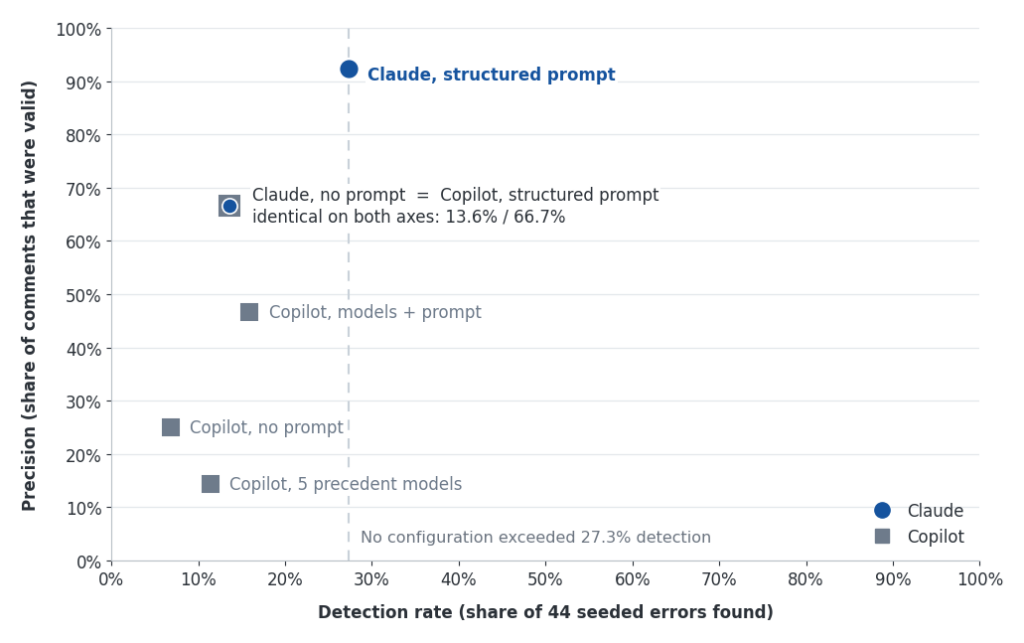
Only one configuration performed strongly on both dimensions: Claude with a structured prompt, at 27% detection and 92% precision. Nearly every comment it raised was a real finding, yet it still missed 73% of seeded errors. Every other setup traded one axis for the other.
The configuration with the next-highest detection, Copilot with both precedent models and a prompt, got there by raising far noisier output: fewer than half of its comments were valid. And two very different setups landed on identical numbers. Claude with no prompt at all and Copilot with a carefully structured one both scored 13.6% detection and 66.7% precision.
Can you trust a single AI pass?
Run the same tool over the same model twice and you do not get the same answer. In a second pass, Claude dropped three material findings it had correctly identified the first time. Copilot dropped two. Nothing about the model changed.
If you run one pass and treat the output as your review, that is the risk in a sentence: an issue caught today can vanish silently tomorrow. A single AI pass is a draft, and a different draft every time. It is not a dependable record of what a financial model contains.
Does a structured prompt beat feeding AI old models?
The most useful finding for anyone using AI in financial modelling: methodology beats memory.
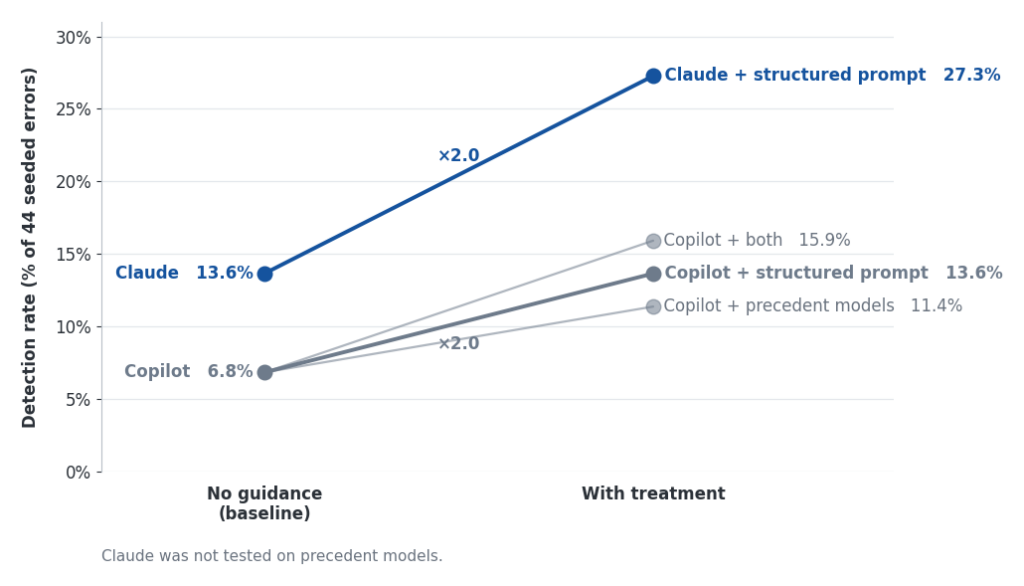
A structured prompt specifying full-workbook coverage, exact cell referencing, formula-level testing and defined evidence thresholds doubled detection for both tools. Giving a tool five hypothetical precedent financial models to learn from did not. Copilot’s precedent run generated more comments than any other, 35 of them, but only five were material. The extra context added noise faster than insight. Combining both gave Copilot its best detection at a cost in precision.
The lesson is that a bigger model or more history did not move the results. Codified review method did. Testing Claude with precedent models of its own is a future project for us.
It is worth being concrete about the two ends of that spectrum. The no-prompt runs used a single plain instruction, close to what anyone would type:
The no-prompt instruction, in full
“Act as a model auditor and review this Model. Generate a table with the following: Issue number, Graded severity (1- high, 2- medium, 3-low), Model cell reference (e.g., Sheet1!E12), Explanation commentary.”
So what does a structured prompt contain, if it makes that much difference? It is a documented review methodology, around seventeen pages of it. One section, on reserve accounts, gives the grain:
Extract: reserve-account knowledge, one of around twenty sections
Every reserve should reconcile: opening balance + deposits + interest − withdrawals − releases = closing balance.
Tested across the DSRA, maintenance, repowering, decommissioning and minimum-cash reserves. Defects the section looks for include:
- A deposit not restricted by available cash
- A target based on the wrong debt service
- An omitted withdrawal, deposit or interest accrual
- A reserve funded after its required date
- A release before the liability is paid
- A closing balance left out of the cash line
- A reserve balance remaining after the project ends
The point is not the prompt itself. The lift came from documented method, applied consistently, rather than anything the tool worked out on its own.
Where AI model review is weakest, and it is not random
The misses are not scattered evenly. We sorted the 44 seeded errors into five types, and a pattern shows up: the tools do best on errors that read like language, and worst on errors that need either patient mechanical checking or a view of what should be present but is not.
Row-level formula inconsistencies are the classic case. A formula pattern breaks partway across a row with no visual cue. Claude with a structured prompt caught two of four, a subset of the formula construction grouping, and none of the four Copilot configurations caught any. Checks of that kind are mechanical, and mechanical checking is what rule-based testing does with certainty, run after run.
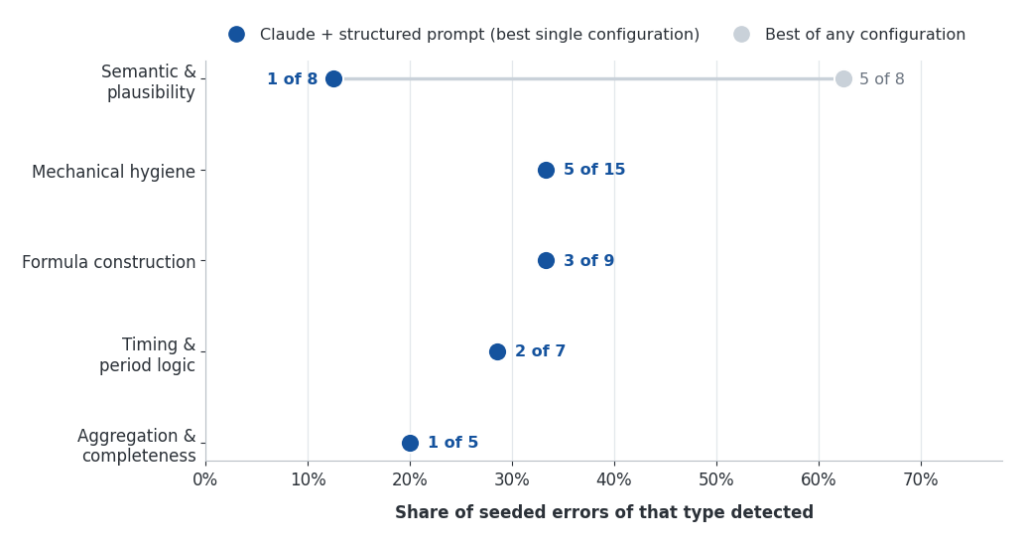
The full matrix makes the pattern hard to miss.
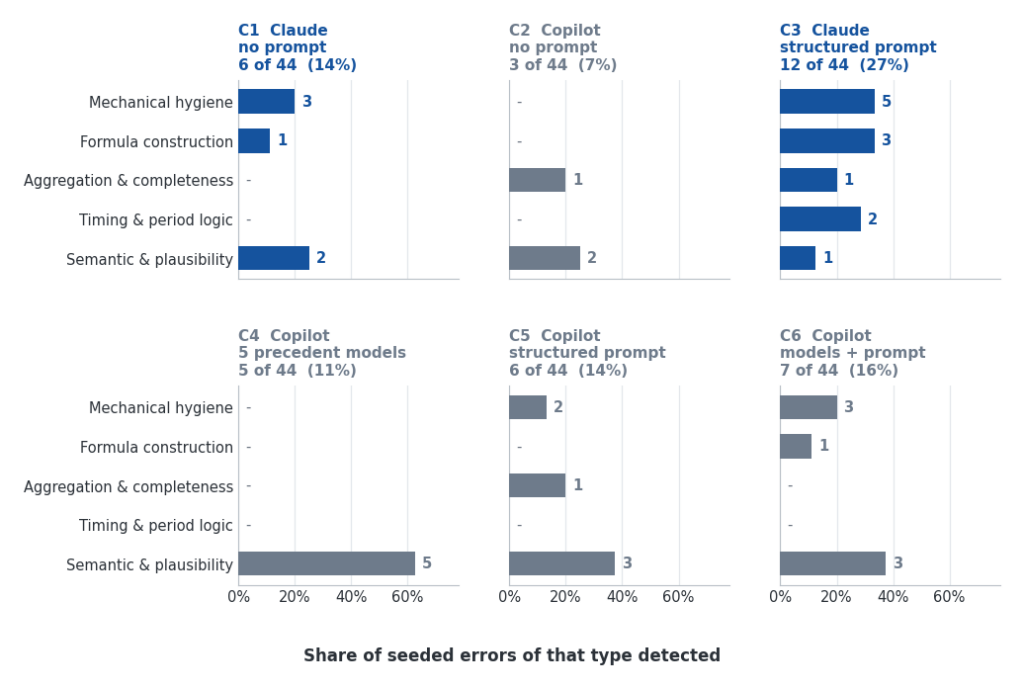
| Error type | Seeded | C1 | C2 | C3 | C4 | C5 | C6 |
|---|---|---|---|---|---|---|---|
| Type 1: mechanical and structural hygiene | 15 | 3 | none | 5 | none | 2 | 3 |
| Type 2: formula construction and referencing | 9 | 1 | none | 3 | none | none | 1 |
| Type 3: aggregation and completeness | 5 | none | 1 | 1 | none | 1 | none |
| Type 4: timing, flags and period logic | 7 | none | none | 2 | none | none | none |
| Type 5: semantic consistency and output plausibility | 8 | 2 | 2 | 1 | 5 | 3 | 3 |
| Total detected (of 44) | 44 | 6 | 3 | 12 | 5 | 6 | 7 |
| Detection rate | none | 14% | 7% | 27% | 11% | 14% | 16% |
Table 1: Detections by error type. C1 Claude, C2 Copilot, C3 Claude with a structured prompt, C4 Copilot with precedent models, C5 Copilot with a structured prompt, C6 Copilot with both. A dash means none.
Two things stand out. The weakest categories are aggregation and completeness, where a line item is quietly missing from a total and no configuration caught more than one of five, and timing and period logic, where only one configuration caught anything at all. Errors of omission and timing do quiet damage because nothing on the surface looks wrong.
None of this says AI is bad. It says its blind spots are consistent, and anyone relying on it should know exactly where they sit.
Why reference quality decides whether an AI finding is usable
A finding a reviewer cannot locate is not a finding. Claude returned an exact Sheet!Cell reference for every comment it raised. Copilot’s references were often vague, pitched at schedule or section level. In some cases they pointed to the wrong place entirely.
Any comment has to be checkable: whoever reads it needs to jump straight to the cell and reproduce the issue. Precise references are the difference between a comment that saves time and a comment that wastes it.
Where AI helps in financial model review
The same data that argues against relying on AI alone also shows where it adds value. Turn the error types the other way up: proportionally, the tools did best on semantic and plausibility checks. Does this metric make economic sense? Is a ratio defined consistently? Is an output obviously implausible? On this evidence, a few uses hold up:
- A fast first-pass sweep. Run a structured AI pass before a model goes anywhere important. It clears a real slice of the surface issues in minutes, so later review starts from a cleaner base.
- Economic sense-checking. Point it at the story the numbers tell: consistent definitions, plausible outputs, ratios that should reconcile. This was the strongest category across the tools as a whole, though it was the precedent-model run, not the structured-prompt run, that caught the most here.
- Explaining an unfamiliar model. Ask it to walk the logic and trace where a number comes from. Claude in particular was the clearest at explaining its reasoning.
- Drafting review comments. Turn raw observations into clear, cell-referenced notes. That is packaging, and AI is good at packaging.
- Raising timing questions, with a good prompt. The only configuration that caught any period-logic errors was Claude with a structured prompt. With the right instructions, AI can raise timing questions a reader skims past.
Used as an assistant and a first pass, it adds real value. Used as the reviewer of record, it does not hold up on this evidence.
Even where it helps, the output still has to be checked
An AI review is not self-certifying. Every comment it raises, right or wrong, has to be checked by someone who knows the model, and a tool that over-flags adds that work instead of removing it. In our runs the cleanest configuration produced about one comment to check for every real finding. The noisiest produced seven.
“It flagged something” is not the same as “it saved the work”. The more a tool over-flags, the more reviewer time it consumes on the way to a usable answer.
So, can Claude replace a financial model audit?
No. The strongest configuration we built caught roughly a quarter of the seeded errors. It could not repeat its own results, and it missed most heavily in the categories where errors do the quietest damage: completeness and timing. Neither a better prompt nor precedent exposure closed that gap, and the tool cannot tell you which three-quarters it missed.
Used as an assistant, for a first pass, a sense check or clearer review comments, AI is useful. Used in place of independent review, it leaves most of what matters uncaught. The question in the title has a short answer. The useful work is in knowing where the tool stops.
What this benchmark does not prove
This was a directional exercise, not a controlled trial. The six cases varied tool, prompt and precedent access in combination, and each was scored on a single pass despite the run-to-run variance we observed. The results show how these tools behaved under the cases we ran. They do not isolate the effect of each variable, and they do not prove one tool will always beat another.
Full results of the AI model audit test
| Case and configuration | Comments | Material | Detection | Precision | Noise |
|---|---|---|---|---|---|
| 1. Claude, no prompt | 9 | 6 | 13.64% | 66.67% | 33.33% |
| 2. Copilot, no prompt | 12 | 3 | 6.82% | 25.00% | 75.00% |
| 3. Claude, structured prompt | 13 | 12 | 27.27% | 92.31% | 7.69% |
| 4. Copilot, five precedent models | 35 | 5 | 11.36% | 14.29% | 85.71% |
| 5. Copilot, structured prompt | 9 | 6 | 13.64% | 66.67% | 33.33% |
| 6. Copilot, models and prompt | 15 | 7 | 15.91% | 46.67% | 53.33% |
Table 2: The same 44-issue scorecard applied to every configuration. Case 3, Claude with a structured prompt, is highlighted as the best performer.
Full disclosure: Claude helped edit this article.