
MMRA tutorial workbook
The MMRA example from this tutorial, built out in Excel and ready to follow along with your own numbers. Excel binary workbook (.xlsb).
Enter your details and we will email you the workbook.
Loading the form…
The form did not load. Send us an enquiry and we will email you the workbook.
When capital expenditure is lumpy or large, you often need to model a major maintenance reserve account (MMRA). This tutorial explains what an MMRA does and how to code it and link it to the financial statements.
During the operational phase of a project, capital investment is needed to keep the project running as planned: resurfacing a runway, a planned lane widening on a toll road or the major overhaul of a generation set. Like saving for a rainy day, the MMRA builds up funds so they are there when needed, if not a little before.
Lenders typically require an MMRA where the project’s maintenance cycle brings large maintenance costs relative to its operating cash flow. In those circumstances lenders want cash set aside, equal to the estimated maintenance costs, in the year the costs fall due.
For lenders, this matters because maintenance that is not done when scheduled can impair the project’s ability to repay the outstanding loan on time.
How an MMRA is funded in a project finance transaction
The major maintenance reserve account is usually funded up to a target balance. The target might be 6, 12, 18 or 24 months of future major maintenance capex, or a fixed amount.
As with the debt service reserve account (DSRA), the term sheet usually sets the funding method, typically one of these:
- Funded in full on the last day of construction
- Partly funded on the last day of construction, then built up from the project’s cash flow
- Built up entirely from the project’s cash flow
In the cash flow waterfall, the cash available to fund the MMRA usually ranks after operating cash flow but ahead of debt service.
Learn this in a room
Best Practice Project Finance Modelling
Build and sensitise robust cashflow models from scratch, faster in Excel. Hands-on, practitioner-led, in person or online. See dates and book your place.
Modelling the target balance, deposits and releases
The example in the workbook works on these assumptions:
- The project has completed construction
- The product price used for revenue is cyclical from year to year
- The product price dips by 20% in operational year two
- There is a large major maintenance capex in year two
- The project must maintain an MMRA during operations
- The MMRA provides for the next 24 months of capex
The MMRA is partly funded on the last day of construction.

The mechanics of an MMRA are similar to those of a DSRA: cash in and cash out.
Cash in: additions from the project’s cash flow
- Funding from cash flow: cash from the project to top the MMRA up to its target balance
Cash out: releases to the project’s cash flow
- Release to cash flow: cash released from the available balance to fund the shortfall in operating cash flow needed for the maintenance capex
- Release of excess cash: cash released to bring the balance down to the target
Figure 2 shows the elements and calculations. The target balance is the sum of future expected maintenance capex, calculated dynamically with SUM(OFFSET). Our tutorial on the OFFSET function in Excel explains the combination.
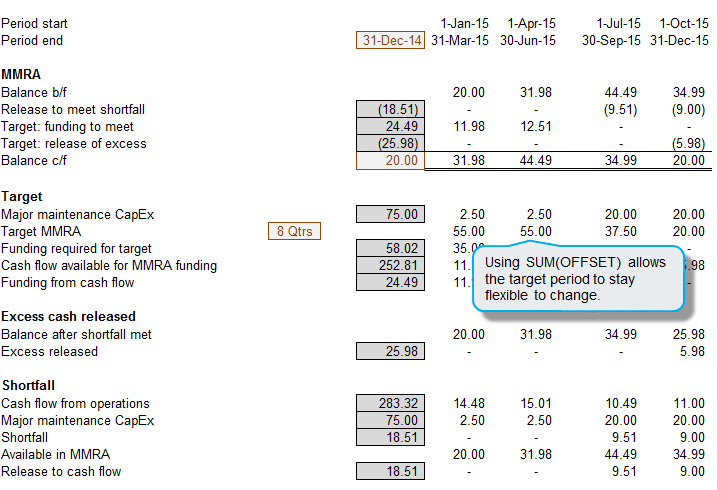
Interest is generally earned on the opening balance of the account and recognised in the same way as interest on cash balances in the cash flow waterfall.
Where the MMRA sits in the financial statements
Cash into and out of the MMRA is linked into the cash flow waterfall, and the closing balance forms part of current assets on the balance sheet.
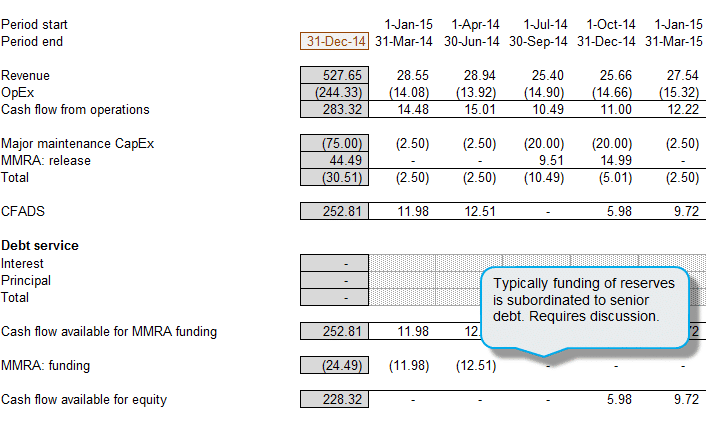
In the first year the product price, and so revenue, is expected to be higher. The MMRA is therefore built up to its target balance in the first year of operations.
Prices dip in the second year, just as a large major maintenance capex falls due. Because the MMRA balance can fund this capex, the net major maintenance capex stays constant.
With an MMRA, lenders make sure funds are set aside from ongoing operations, ready to meet this capex when it falls due. That reduces the stress lumpy cash flow would otherwise put on the project, and so on debt service.
Circular references and debt service shortfalls
As with the DSRA, take care to avoid circular references when modelling the account, especially if the initial balance is funded by debt. There is usually no logical reason for the MMRA itself to cause a circularity.
Lenders often ask how the account works if there is a shortfall in debt service. If cash is in the MMRA and the project has no other funds to make a payment due to lenders, can the lenders draw on it? Where that is allowed, the balance usually has to be restored afterwards.
MMRA questions
What is an MMRA?
A major maintenance reserve account is a cash reserve built up during a project’s operational phase to fund large, lumpy maintenance costs, such as resurfacing a runway or overhauling a generation set, when they fall due.
How is an MMRA different from a DSRA?
Both are reserve accounts with similar funding and modelling mechanics, but they cover different risks. A DSRA covers a shortfall in scheduled debt service. An MMRA covers large, irregular maintenance capex that would otherwise put lumpy pressure on the project’s cash flow.
Can lenders use the MMRA to cover a debt service shortfall?
Lenders often raise this. Where the term sheet allows it, the balance usually has to be restored afterwards if it is drawn to pay debt service.
How do you avoid circular references when modelling an MMRA?
Take particular care where the initial balance is funded by debt. There is usually no logical reason for the MMRA itself to create a circularity, so a circular reference here often points to an error in how the account is linked.