
Mining stockpiles tutorial workbook
Excel binary workbook (.xlsb). The mining schedule, milling calculation and ore and contained gold stockpile accounts from this tutorial.
Enter your details and we will email you the workbook.
Loading the form…
The form did not load. Send us an enquiry and we will email you the workbook.
In many mining projects, open pit or cut mining starts months or even years before the milling plant operates. The stockpile that builds up needs careful treatment, so that the model mills the right grade of ore and the balance sheet reports the right value for the stockpile.
This tutorial walks through one approach to modelling stockpiles:
- Calculating contained gold from the mining schedule
- Building the ore stockpile account
- Calculating the ore milled from the ore mined
- Modelling the contained gold stockpile account
Stockpiles are a common challenge in mining models, and this tutorial draws on our Financial Modelling for Mining Projects course. A few things built in from the start keep the calculations transparent and easy to follow.
The mining schedule
The mining schedule summarises the physical side of mining and usually comes from the engineers. At its simplest it holds the ore mined (tonnes) and the ore grade (grams per tonne) for each type of ore, as in Figure 1.
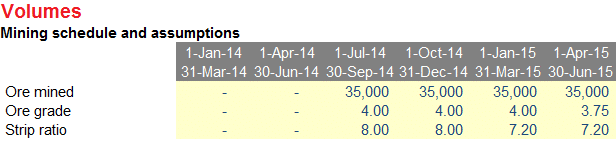
The schedule also holds either the strip ratio or the waste mined (tonnes). Waste mined is outside the scope of this tutorial, but it drives mining costs such as haulage and drill and blast.
Learn this in a room
Financial Modelling for Mining Projects
Discover how to create effective financial models for mining projects. Learn from experts and build real-world applications.
Contained gold: additions to the stockpile
First, set up the period start and end dates and the binary flags for the development and milling phases at the top of the worksheet.
Use the LOOKUP function to bring in the ore mined and ore grade from the inputs sheet. Contained gold is the ore mined multiplied by the ore grade, as Figure 2 shows.
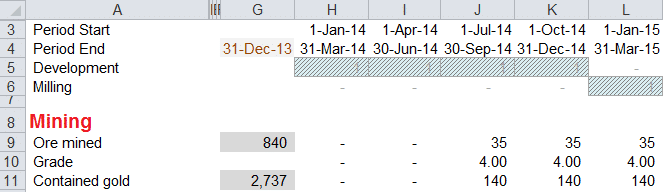
On the inputs sheet, row 22 holds the years, row 23 the ore mined and row 24 the grade, in columns E to AB. In the calculation sheet:
- Ore mined (H9) = LOOKUP of the period’s year (N$4) in row 22, returning row 23, × SUM(N$5:N$6) ÷ Thousand
- Grade (H10) = LOOKUP of the period’s year (N$4) in row 22, returning row 24, × SUM(N$5:N$6)
- Contained gold (H11) = ore mined (H9) × grade (H10)
The ore stockpile account
Two accounts track the stockpile: one for ore mined and one for contained gold, as Figure 3 shows.
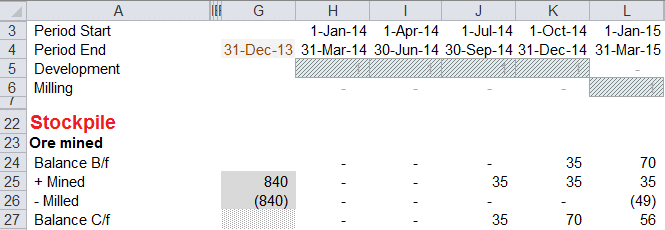
Each is an account, with an opening and a closing balance:
- Balance b/f (H24) = balance c/f of the previous period (G27)
- Balance c/f (H27) = balance b/f (H24) + mined (H25) − milled (H26)
- Ore mined (H25) comes from the mining section (Figure 2, H9)
- Ore milled (H26) comes from the milling section below (Figure 4)
Milling: deductions from the stockpile
The ore milled completes the ore stockpile account. Three things set how much ore goes through the milling plant:
- Plant capacity, assumed at 70kt a quarter
- A ramp-up profile in the early milling years (row 42)
- The ore available in the stockpile (row 45)
The high-grade ore milled is the lesser of the available ore (row 45) and the plant capacity for the period (row 43). If capacity is higher than the available ore, only the available ore can be milled. If the available ore is more than capacity, milling stops at capacity.
Any spare capacity can process lower-grade ore.
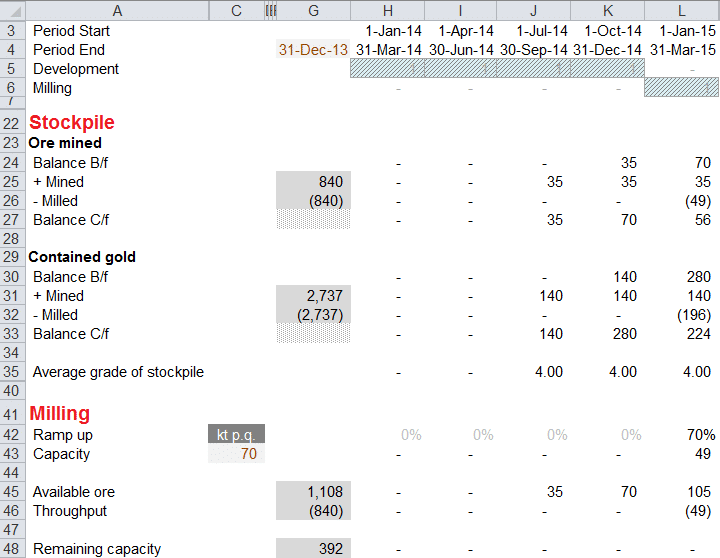
- Capacity (H43) = full capacity (C43) × ramp-up (H42)
- Available ore (H45) = ore stockpile opening balance (H24) + ore mined (H25)
- Throughput (H46) = the lesser of available ore (H45) and capacity (H43)
- Remaining capacity (H48) = capacity (H43) − throughput (H46)
The contained gold account
The last step completes the contained gold account. Like the ore account, it has an opening and a closing balance. The contained gold in the ore mined adds to it, and the contained gold in the ore milled draws it down, as Figure 5 shows.
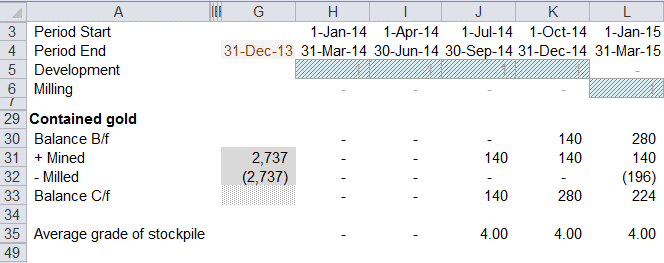
- Balance b/f (H30) = balance c/f of the previous period (G33)
- Balance c/f (H33) = balance b/f (H30) + mined (H31) − milled (H32)
- Contained gold mined (H31) comes from the mining section (Figure 2, H11)
- Contained gold milled (H32) = average grade (H35) × ore milled (H46)
The contained gold milled depends on the ore milled from the previous section and the grade of that ore. The average grade of the stockpile is a good proxy for the grade milled, whatever the grades of the different parcels added over time. It is calculated in row 35:
Average grade=contained gold available (H30 + H31)ore available (H24 + H25)
Why stockpiles matter in a mining model
Most mining companies cannot mill all the ore they mine, so stockpiles are a core part of a mining model. The contained metal in a stockpile also has a value that belongs on the balance sheet.
In our Financial Modelling for Mining Projects course we demonstrate these calculations live, with a best practice approach to the features specific to mining models.
Mining stockpile questions
Why do mining projects need to model a stockpile?
Mining often starts well before the milling plant operates, and mines rarely mill ore as fast as they extract it. The stockpile that results has a value that belongs in the model and on the balance sheet.
Why are there two stockpile accounts, one for ore and one for contained gold?
Ore tonnes and the gold they contain do not move together, because parcels mined at different times carry different grades. Tracking both and calculating the average grade from the two gives the gold actually milled in each period.
How is the ore milled in each period set?
It is the lesser of the ore available in the stockpile and the plant capacity for the period. Any spare capacity can process lower-grade ore.
Why use the average grade of the stockpile rather than the grade just mined?
Ore milled in a period may include material added to the stockpile at different times and grades. The average grade of the whole stockpile is a better proxy for what is milled than the grade of the latest ore alone.